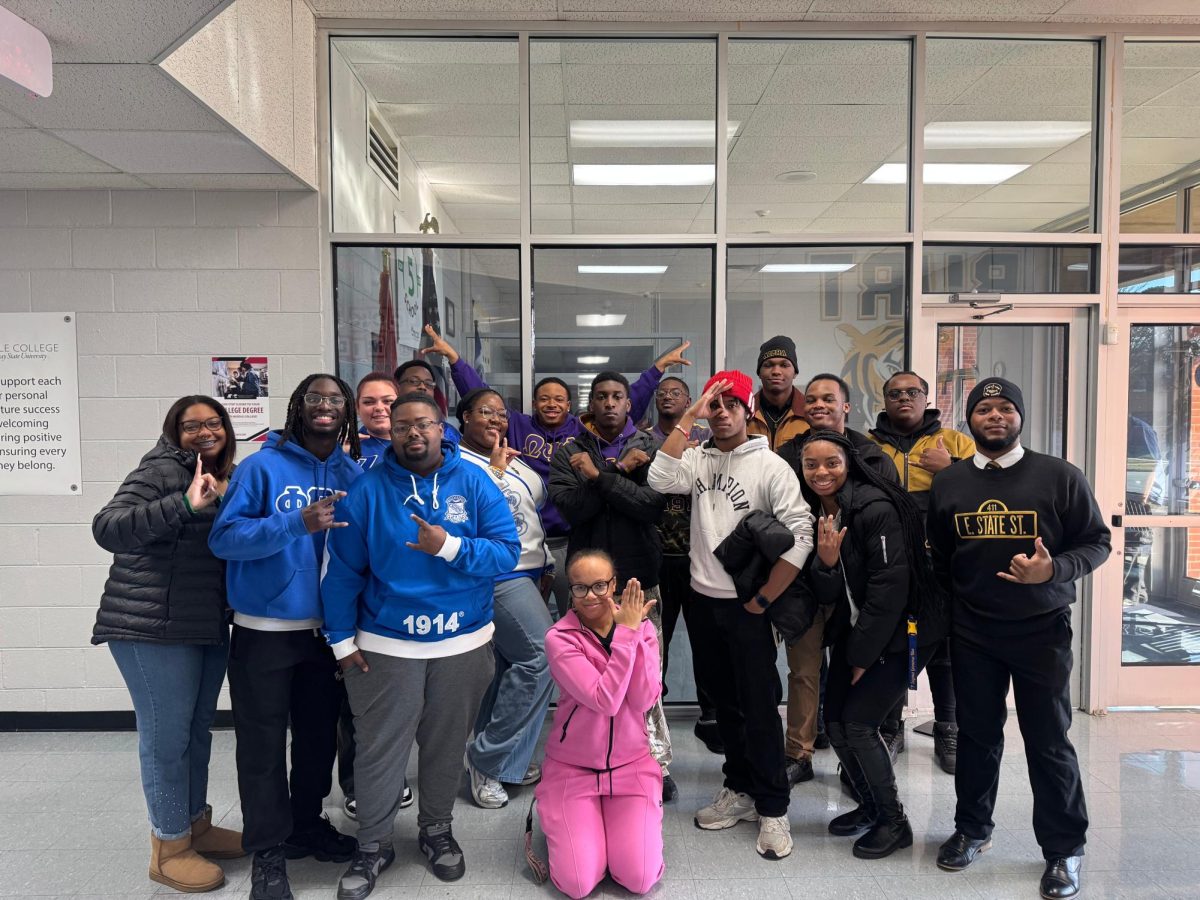
Austin Peay State University students, members of the National Pan-Hellenic Council and community members gathered Monday, Jan. 16, to honor the life and legacy of Dr. Martin Luther King Jr. during the Martin Luther King Jr. march in Clarksville.
Before the march began, the event hosted talks, discussions and debriefs at Burt Elementary School centered on leadership, unity, service and issues currently impacting the community and today’s world. Members of Austin Peay’s National Pan-Hellenic Council worked closely with children throughout the program, helping guide activities focused on Dr. King’s message and impact.
Following the program, participants marched through Austin Peay’s campus and into downtown Clarksville to honor Dr. King’s contributions to the Civil Rights Movement and his continued influence on social justice.
Ahead of the march, members of Austin Peay’s National Pan-Hellenic Council shared how Dr. King’s legacy connects to their organizations and why representation and service remain central to their mission.
Earnest Williams Jr., NPHC president and social media chair of the Alpha Rho Chapter of Phi Beta Sigma Fraternity Incorporated, said Dr. King’s mission aligns closely with the values of his fraternity.
“It connects to the mission of our fraternity because Martin Luther King’s goal was to bring people together and to help,” Williams said. “My fraternity embodies people of many different colors and backgrounds coming together to serve, which shows the brotherhood Martin Luther King wanted to bring out.”
Williams said his chapter continues Dr. King’s work beyond the march through consistent service to the community.
“Our principles are brotherhood, scholarship and service,” Williams said. “That service applies to people no matter what background you come from or your financial situation. That’s how we continue Martin Luther King’s dreams, by helping whoever needs to be helped, regardless of color.”
Tylia Williams, a member of Zeta Phi Beta Sorority Incorporated, said participating in the march reflects to the historical significance of the Divine Nine.
“Within the D9, they were the first to allow African Americans to come together in a group where they could feel accepted,” Williams said. “It allowed students to see that college is acceptable for African Americans and that if you are interested in joining an organization for sisterhood or brotherhood, it is the right place for you.”
Qiana Ruth, president of the Gamma Nu Chapter of Zeta Phi Beta Sorority Inc., said being part of the NPHC has shaped her understanding of Black history.
“Being in community with the D9 has shaped the way that I understand and learn about Black history,” Ruth said. “We know the major figures like MLK, Malcolm X and Rosa Parks, but it is also the smaller people who make big impacts.”
Logan Wallace, a member of the Kappa Rho Chapter of Alpha Kappa Alpha Sorority Incorporated, said events like the MLK march strengthen unity among NPHC organizations.
“All of the D9 organizations have different values and reasons for being created, but they all stem from Black excellence and coming together for the betterment of the Black community,” Wallace said. “Events like these allow us to work toward a common goal and further that vision.”
Miles McRee, a member of the Resolute Rho Kappa Chapter of Omega Psi Phi Fraternity Incorporated, said representation at community events carries deep meaning.
“For me, representation is kind of a form of stepping up to a call that’s bigger than you,” McRee said. “Being in those leadership roles, being able to inspire others and being able to show that there’s representation out there matters, because a lot of times we go into these spaces and don’t have a lot of familiarity since we are the only Black people or the only minorities in the field. Going out and taking that first step shows others, ‘Hey, I’m here, so you can feel comfortable being here as well.’”